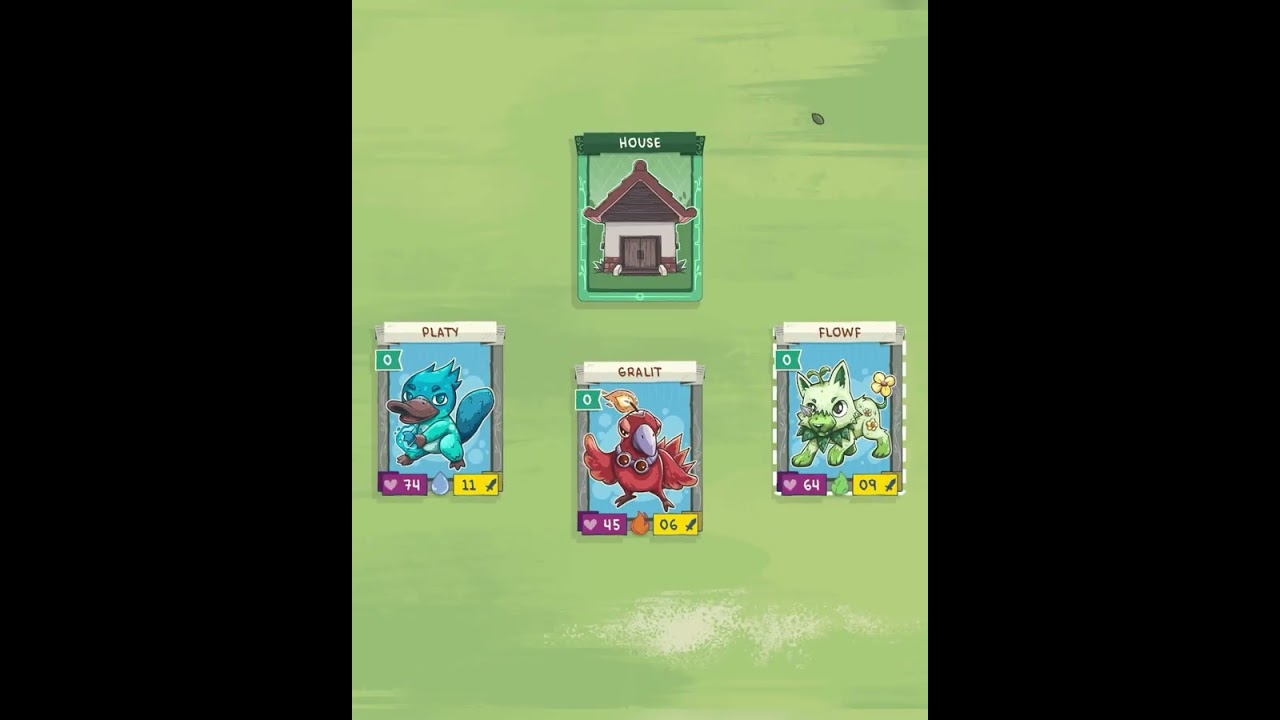
The three starter choices
Official Stackmon posts introduce three possible starters: Flowf, Gralit and Platy. Their published types are Plant, Fire and Water respectively.
- Flowf — Plant type
- Gralit — Fire type
- Platy — Water type
How to choose without a fake ranking
The official store confirms that elemental affinities matter in auto-battles, but it does not publish a complete starter stat table or matchup chart. Use the type, abilities and effects shown in your current build instead of assuming a familiar creature-collector triangle proves one option is stronger.
- Read each starter card before confirming.
- Compare the abilities and effects shown by your build.
- Choose the play pattern you want to learn first, not an unsupported tier label.
What to check on the choice screen
A fair best-starter comparison would need matching stats, abilities, evolution paths and a clear answer about obtaining the other two choices later. Until those details are public, read the live cards and choose the play style you want to learn first.
Use preference before performance data exists
A first choice can still be deliberate without a tier list. Start with the one official difference that is stable: Flowf is Plant, Gralit is Fire and Platy is Water. Then compare the artwork and the same-name medal you most want to track. The Starter Picker uses exactly those three inputs and explains its result as a preference match. It does not smuggle promotional card numbers into a strength score or pretend that a familiar elemental triangle has already been reproduced in Stackmon.
- Choose the type you are most interested in learning.
- Choose the same-name medal that gives you a motivating long-term marker.
- Use visual preference as a valid tie-breaker when performance data is incomplete.
Read the live card before confirming
The public starter frame shows all three creatures, but its card values come from one promotional capture. Before confirming a choice, inspect the ability wording, displayed values, type icon and any choice warning in your game. If the screen says the decision cannot be changed, treat that live message as the final word.
Plan the first session around learning, not optimization
Whichever starter you choose, use the first session to learn how its type label, ability text and work interactions are presented. Keep gathering, camp development and battle preparation as separate observations. That gives you a clean baseline for later comparisons. An early loss does not prove the starter is weak: equipment, opposing abilities, progression and affinity feedback are also confirmed battle inputs. Change one variable before repeating a fight instead of restarting around an unsupported ranking.
How to compare starters after one full run
A fair comparison needs the same game version, similar progression and the same target encounter. Compare the card fields, equipment, opponent, affinity feedback and result. Do not compare a newly obtained card with a trained starter and assume the difference comes from the species alone.