Steam includes a first-Shiny capture achievement but does not publish encounter odds, route boosts or a complete visual-identification rule. Use a repeatable hunting routine rather than trusting a fabricated percentage.
Player answer
Quick answer
Choose one repeatable encounter source, keep the route and build constant, record every attempt, and only call a result Shiny when the current game identifies it—not because a color looks unusual in a compressed image.
Fix one route or source and record the build.
Log attempts and the game’s visible variant label.
Separate Shiny captures from Foil captures and Foil creation.
For exact details: Use current creature cards to compare markers and stats, and keep every attempt in one version-labeled sample if you want to estimate odds.
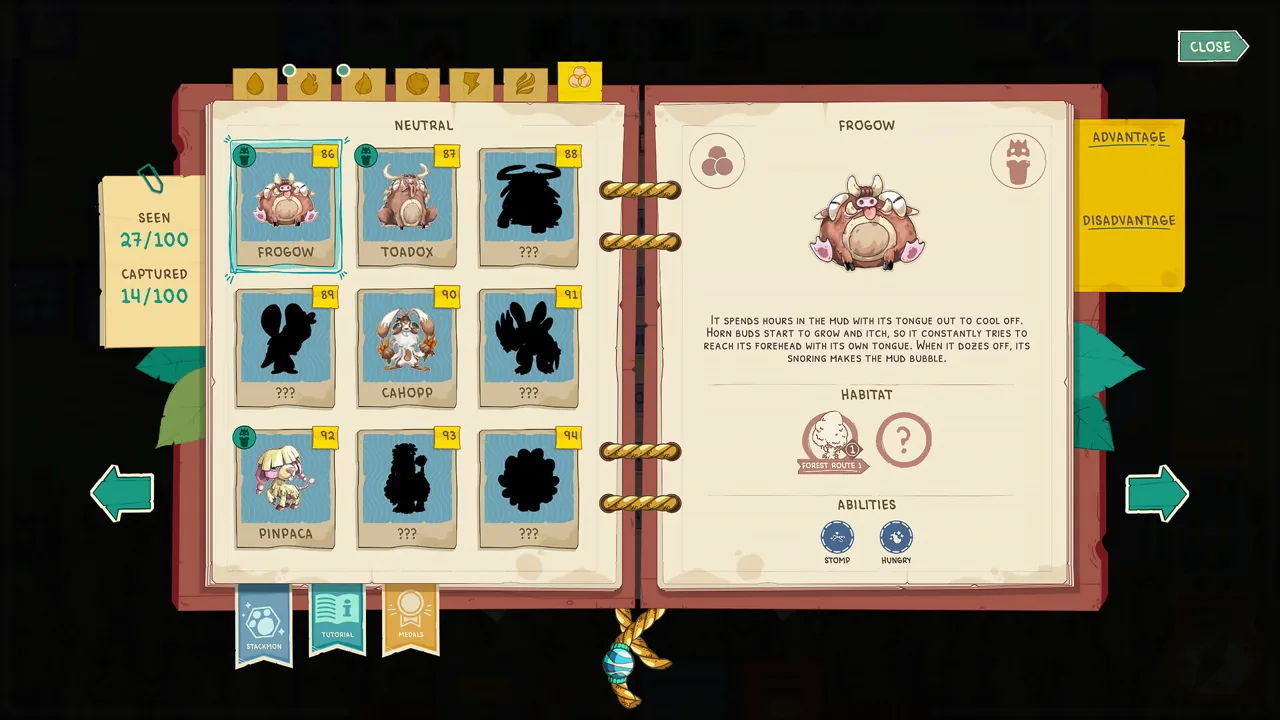
The Field Guide groups discovered records and silhouettes by type. Use its tabs to check the current live roster. Official Steam store screenshot
Start with the only confirmed Shiny milestone
The public Steam achievement Shiny Tracker requires capturing a first Shiny Stackmon. That confirms the target and the relevant action—capture—but it does not reveal whether every encounter source can produce one or whether odds vary.
Keep Shiny and Foil records separate
The developer confirms the variants cannot stack: Shiny has the maximum base stats available to that Stackmon, while Foil is visual only. Use separate columns for Shiny encounters, Foil encounters and created Foils.
Use the Odem Egg chances shown in 9.0.76
Patch 9.0.76 adds Foil and Shiny chances to the Odem Egg. Record the percentages shown in your current game instead of copying a fixed rate from an older guide.
Wait before evolving a valuable Shiny
The August 21 Launch Update says Shiny Stackmon losing perfect attributes upon evolution is still being worked on. Preserve the save and consider waiting for a later fix before evolving one you want to keep.
Run one controlled route
Pick one wild encounter source, note the route, creature pool and session start time, then avoid changing equipment, progression state or game version during the sample. A mixed route can produce a large attempt count that answers no clear question.
Log attempts, not only successes
For each attempt, note the number, creature name, source, visible variant wording and result. Save a screenshot of the first Shiny and its in-game identifier. Failed attempts matter because they define the denominator of your personal sample.
Use an attempt log instead of guessing the odds
A personal run can show that a method worked once, but it cannot establish the game-wide probability from a small sample. Record “1 result in my attempts” rather than turning it into a universal percentage.
Recheck after every patch
If the developer changes encounter pools, booster contents or variant systems, begin a new version-labeled sample. Do not append post-patch attempts to an older dataset as though the probability were unchanged.